
Vertical vs. horizontal AI: why industry-specific tools often fit better
Research, trade-offs and six buyer questions for comparing vertical AI tools with horizontal platforms, from model evidence to workflow and approvals.
Vertical AI often fits better because the workflow, records, vocabulary and approval paths are designed around one industry, not because it necessarily uses a better model.
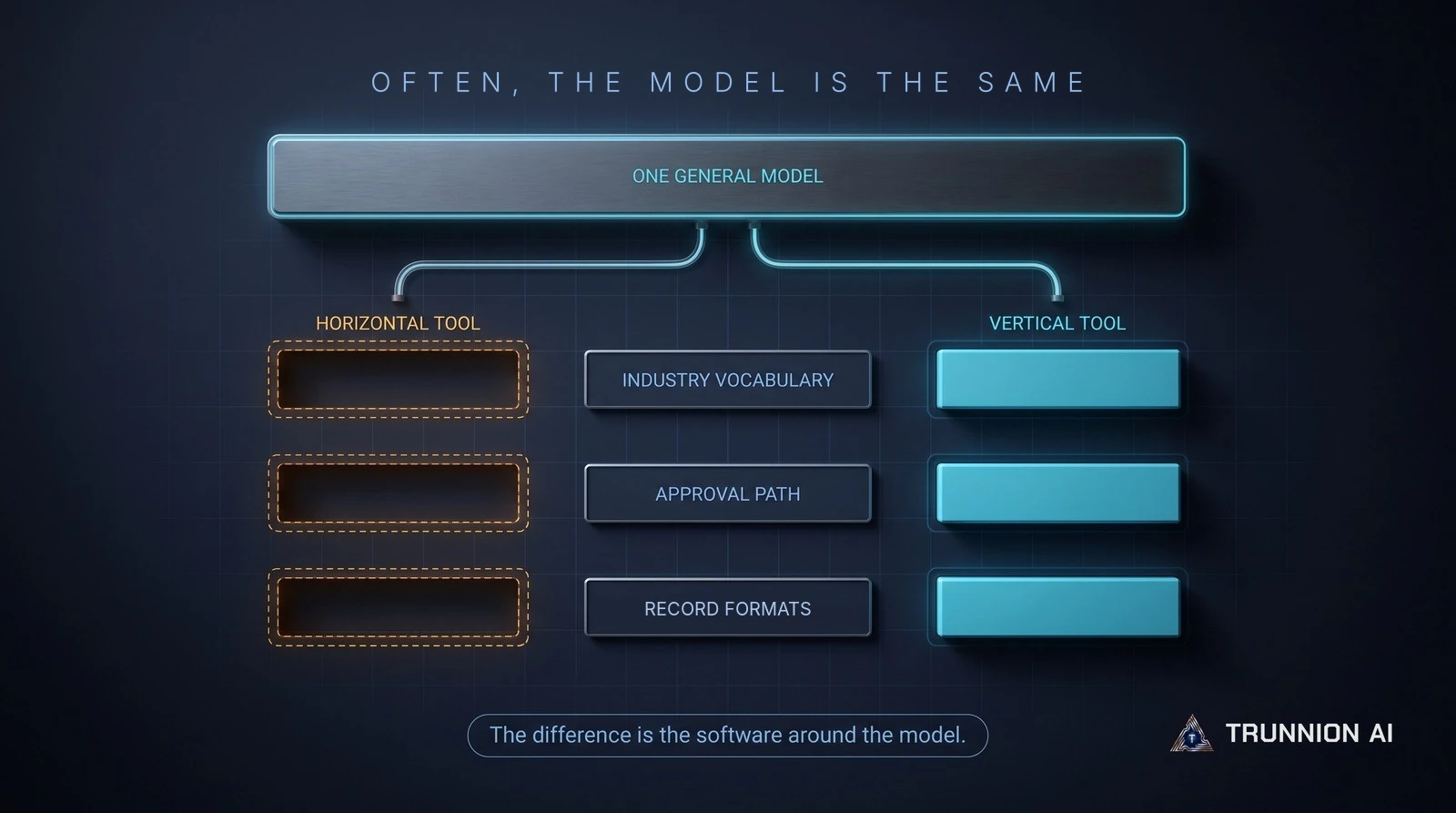
You already know the horizontal pitch: one tool, any industry, start Monday. A vertical tool starts from one industry's workflow, records and decisions instead, so that knowledge is already in the product.
Most explanations of the difference say the vertical tool has a smarter model. The research below does not support that, and this post does not make the claim. In our view the difference is real, but it sits in the software around the model. What follows is the evidence, the trade-offs and six questions to ask any vendor before you buy.
Does the specialist model win?
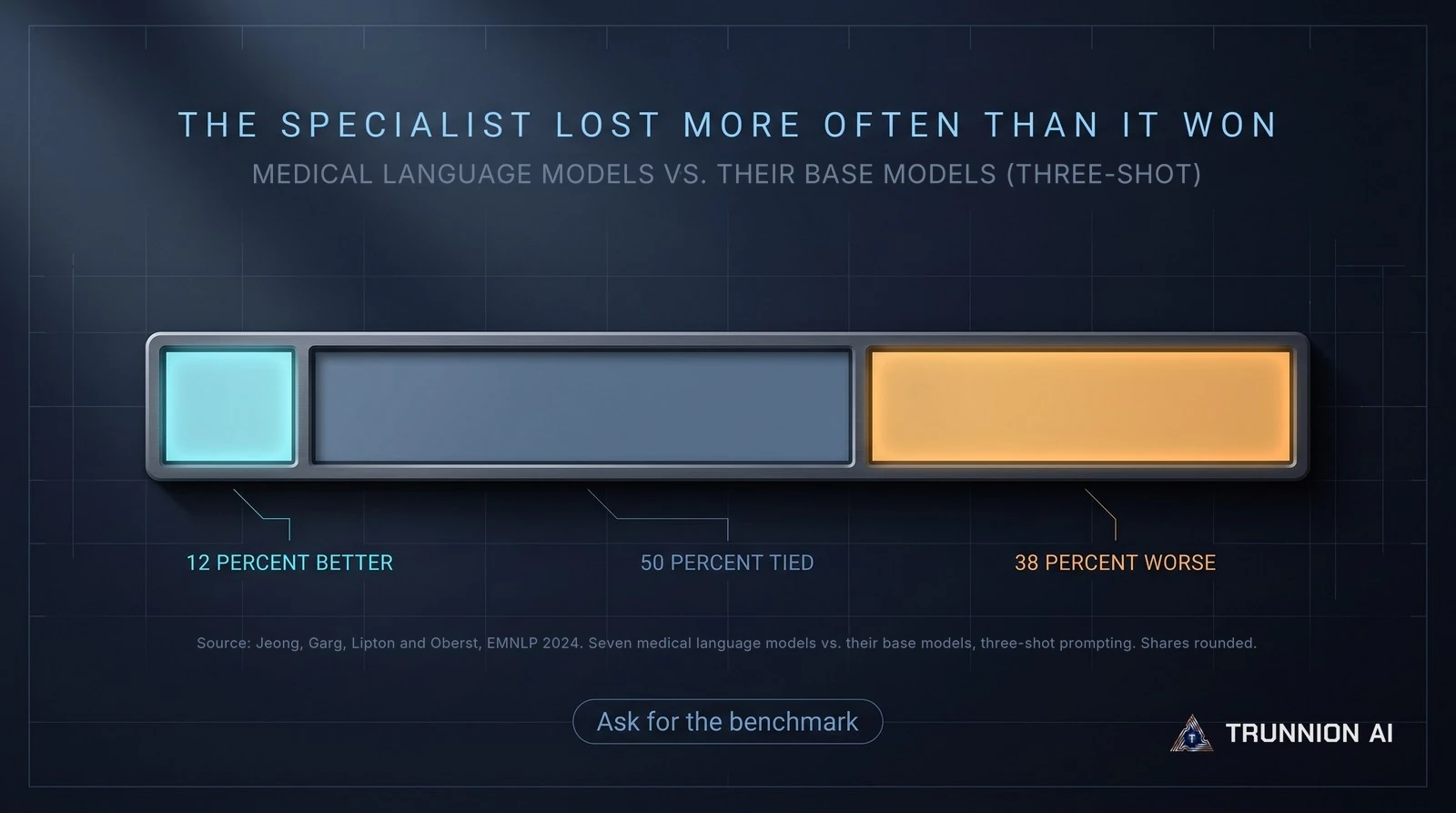
A peer-reviewed study at EMNLP 2024 by Jeong, Garg, Lipton and Oberst compared seven medical language models, each against the general model it was built from. The researchers tuned prompts separately for each model so neither side was handicapped, and they accounted for statistical uncertainty.
In the three-shot setting, the medical model beat its general base model in 12.1 percent of comparisons. It tied in 49.8 percent. It was worse by a statistically significant margin in 38.2 percent. The specialist was worse than its starting point roughly three times as often as it was better. The study also reports that two medical vision-language models failed to improve consistently.
That is one study in one field, so we read it as a warning about a kind of claim, not as a law of nature. The claim is "our model is better because it was built for your industry." If a vendor sells on the strength of the model, ask for the benchmark.
Why this matters more in 2026 than it did in 2023
The models converged. Stanford's AI Index 2026 reports the top four models clustered within 25 Elo points on Arena ratings and says competitive pressure is shifting toward cost, reliability and domain-specific performance. The report repeats the point: as leading models get harder to separate on benchmarks, cost, latency, reliability and domain-specific optimization may play a greater role in adoption. It also cautions about the reliability of Arena ratings, so treat the 25-point figure as a rough signal.
Our reading: when the models were far apart, picking the model was the decision. Now that they are close, we think the model is nearer to a commodity and the decision moves to everything built around it. That is our opinion. The report describes the convergence and the shift in pressure. It does not draw that conclusion.
What is actually industry specific
Not the model. The workflow. A wedding vendor and a waste hauler do not share a workflow. They use different words, keep different records and answer to different people when something changes. A tool that knows those three things on day one starts ahead of a tool that has to be taught them.
That gives three questions to ask of any tool that calls itself vertical:
- What words does it already know?
- What records does it already hold?
- Who does it expect to approve things?
A tool that answers all three from the industry's own habits is vertical in a way that matters. A tool that answers "you tell us" to all three is a general tool with an industry name on the box. That is our opinion, not a measured result.
The table below sets the two kinds of tool side by side. In our view only two of the nine rows usually decide a purchase: where the industry knowledge comes from, and who carries the setup work. The model is the row buyers expect to matter and, going by the study above, often does not.
| Dimension | Horizontal tool | Vertical tool |
|---|---|---|
| Model | Frontier general model | Often the same kind of general model |
| Industry knowledge | Your team supplies it | Built into the product |
| Vocabulary and records | Generic, mapped by you | The industry's own |
| Approval paths | Configured after purchase | Designed in from the start |
| Workflow fit | Adapted by you | Starts from the industry's workflow |
| Who owns the fit | You, after purchase | The vendor, by design |
| Breadth of fit | Any industry, shallow | One industry, deep |
| Setup work | Repeated by every customer | Done once by the vendor |
| Business risk | Spread across industries | Concentrated in one industry |
Setup work is the row buyers underprice. With a general tool, someone on your team writes down the vocabulary, maps the records and configures the approval steps, and every customer repeats that work. A vertical vendor does it once for the whole industry. We think the trade is worth making visible before you sign, because setup work skipped at the start tends to come back later as a bill.
For a broader architecture-level comparison, see our vertical versus horizontal AI platforms guide.
What this looks like as a business, and what depth costs
Vertical software is a category with public filings.
Veeva's annual filing describes the company as an industry cloud provider for the global life sciences industry. Procore's filing explains why construction needs software of its own, listing four defining characteristics of the industry: custom projects, a mobile and decentralized workforce, complex stakeholder dynamics and constant change.
| Company | Built for | Revenue, 2024 | Revenue, 2025 |
|---|---|---|---|
| Procore | Construction | About $1.2 billion | About $1.3 billion |
| Toast | Restaurants | $4,960 million | $6,153 million |
Revenue as reported in each company's annual 10-K filing.
What depth costs. Our view is that the price of depth is concentration.
Veeva's filing states that nearly all of its revenue comes from customers in the life sciences industry, and it warns that conditions affecting that industry could also hurt the company. Procore's filing says its pricing generally depends on the products a customer subscribes to and the annual dollar volume of construction work run on its platform. Our inference is that Procore's results are therefore tied to the health of construction.
A vertical vendor's fortunes are tied to one industry's health. That is the trade. We are not claiming vertical companies grow faster than horizontal ones, and nothing in this post shows that they do. It is worth making the trade knowingly.
Choosing when a general tool is enough
We would not argue for a vertical tool in every case. A general tool is a reasonable choice when the work is one-off, when it does not depend on industry records, or when the team needs to start today and can live with a shallow fit. Drafting, summarizing and brainstorming are examples. Our rule of thumb: the more a task depends on an industry's records and decisions, the more a vertical tool earns its place. This comes from how the work is structured, not from a study.
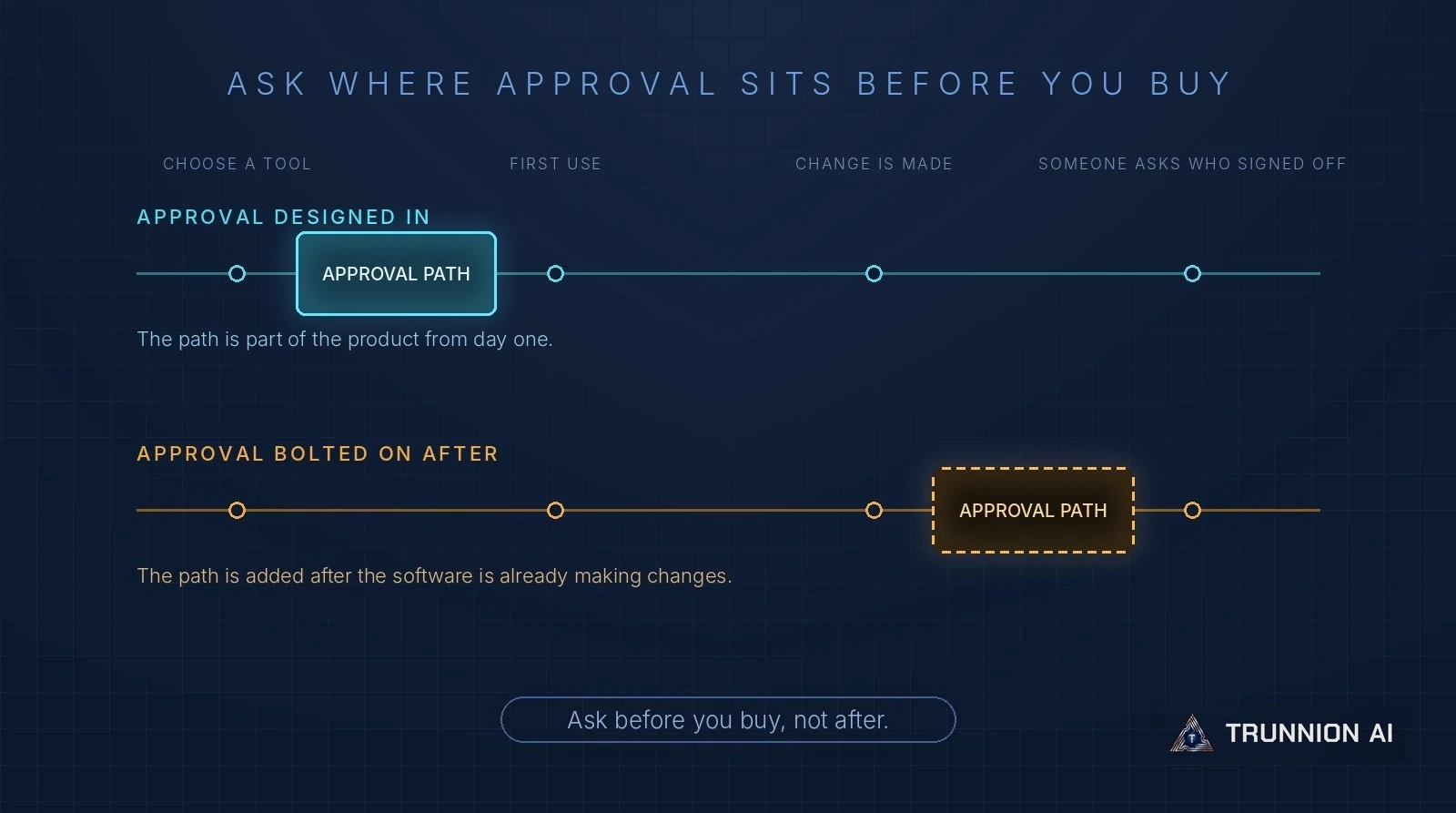
A costly mistake is picking a general tool because it starts fast, then bolting on approval steps when someone asks who signed off on a change. That order is expensive. Approval paths are not a feature you add. They record who has authority over which records, and that differs by industry, by company and sometimes by contract. Retrofitting means discovering the real decision rights after the software is already making changes. This is our argument from how approval works. We do not cite a study for it.
Six questions to ask before you buy
The fix is to ask where approval sits before you buy, not after. Six questions cover it:
- Ask for the benchmark. If a vendor claims a better model, the evidence above puts the burden on them.
- Ask what the product already knows about your industry's records and terms, and what your team would have to supply.
- Ask what it can read and what it can change.
- Ask who has authority to approve consequential work, and where that approval happens in the product.
- Ask which parts of your industry's way of working the product was designed around, and have them name them.
- Ask them to show you how the exact release you would run handles a request it is not permitted to complete.
We think question six best separates vendors who have built the path from vendors who have described it.
Once you have a shortlist, use our seven questions to ask before buying an AI platform to test permissions, approval boundaries, audit records, failure handling, deployment, model choice and pilot design.
How Trunnion AI builds vertical software
Trunnion AI organizes its platforms by industry rather than offering one product for everyone. Each platform starts with the work of its industry. Three examples from trunnion.ai as of October 16, 2026:
| Industry | Platform | What the site calls it |
|---|---|---|
| Events and marketplaces | Zennvue | AI-native operating system for the wedding and event industry |
| Manufacturing | Cortrova | AI-native ERP for manufacturing operations |
| Waste and fleet operations | Haultro | Operations software for waste and fleet |
Each row changes the vocabulary, the records and the people with authority to decide. On approval, the how-it-works overview describes software that proposes work within a configured scope, with consequential work reviewed through a configured human decision path.
Availability and certification posture vary by platform and release, so confirm what is available for your industry before you evaluate it. Trunnion AI's own materials say they describe designed or configurable capabilities, not certifications or proof of production controls, and that actual controls are verified for each release. Treat this section as a way to ask better questions, not as a guarantee.
Next step
If you are weighing a general tool against one built for your industry, the six questions above work on any vendor, not only this one. Take them to whoever is pitching you and write down the answers.
If you want question six answered against a real release rather than a slide, request a technical walkthrough of the Trunnion platform built for your industry. Bring your own workflow to it.
Details current as of October 16, 2026. Next review January 14, 2027. Benchmark results and company filings change, so confirm anything here against the linked source before relying on it.
This article is for general informational and educational purposes only and is not legal, financial, medical, or other professional advice. We make no guarantee that it is accurate, complete, or current. The views expressed are those of the author and do not necessarily represent Trunnion AI. Use of this information is at your own risk.
Sources
Accessed October 16, 2026.
- Jeong, Garg, Lipton and Oberst. Medical Adaptation of Large Language and Vision-Language Models: Are We Making Progress? Proceedings of EMNLP 2024, pages 12143 to 12170. Peer reviewed.
- Stanford HAI. Artificial Intelligence Index Report 2026. Chapter 2, Technical Performance, pages 71, 78 and 80.
- Veeva Systems 10-K, year ended January 31, 2026.
- Procore Technologies 10-K, year ended December 31, 2025.
- Toast Inc. 10-K, year ended December 31, 2025.
- Trunnion AI homepage and how-it-works page, read October 16, 2026.
Direct answers
Frequently asked questions
What is the main difference between vertical and horizontal AI?
Horizontal AI provides broadly reusable capability across industries. Vertical AI starts with one industry's vocabulary, records, workflow and decision rights already reflected in the product.
Does a vertical AI tool always use a better model?
No. Vertical and horizontal tools may use the same kind of general model. Buyers should ask for task-specific benchmark evidence rather than infer model quality from an industry label.
When is a horizontal AI tool enough?
A horizontal tool can be a reasonable choice for one-off work, drafting, summarization, brainstorming and tasks that do not depend heavily on industry records or approval paths.
What should buyers ask a vertical AI vendor?
Ask what the product already knows, what it can read and change, who approves consequential work, which workflows shaped the product and how the exact release handles a prohibited request.
Why do approval paths matter when choosing AI software?
Approval paths encode who has authority over consequential changes. Designing them in from the start is different from adding review after software is already acting on records.
What is the main business risk of vertical AI?
Depth creates concentration. A vertical vendor may fit one industry closely, but its results and product direction are more exposed to that industry's conditions.