


FizzSense
Sensor and IoT intelligence for logistics.
FizzSense is an IoT logistics platform designed to forecast tank depletion, surface demand, prioritize service, and improve delivery routes, combining cellular telemetry with predictive analytics for CO2 logistics teams. In active development; the waitlist is open.
FizzSense is a sensor and IoT intelligence platform for CO2 tank logistics, distributors, and restaurant networks, in development at Trunnion AI.
It is designed for policy-based authorization, layered tool controls, reviewable execution records, and human-in-the-loop approval gates, with implementation and tests verified for the exact release, deployed to cloud, on-premise, or fully air-gapped environments (security boundaries). Trunnion AI is aDuskbridge company, built by the team behind Viceroy NM.
Feature highlights.
The capabilities that carry the iot & logistics workflow in FizzSense, on the governed Trunnion control plane: agents draft and route the work while a human operator stays in command.
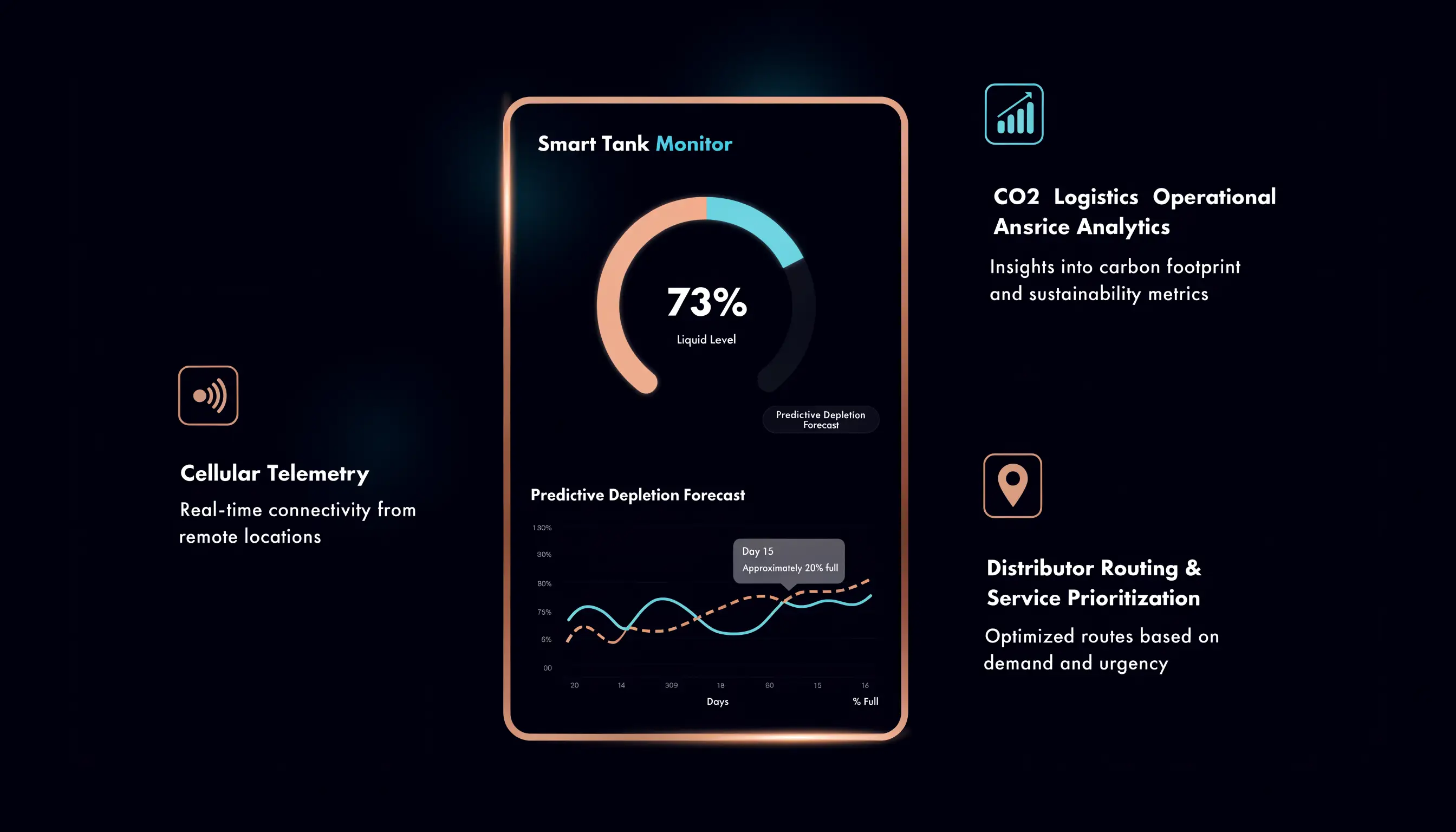
Representative feature highlights. Actual screens vary by deployment and configuration.
Beverage distributors and restaurant networks managing CO2 tank logistics.
What FizzSense does.
Smart tank monitoring and cellular telemetry
Predictive depletion forecasting and demand queues
Distributor routing and service prioritization
Restaurant and distributor portal model
Operational analytics for CO2 logistics teams
Inside FizzSense, capability by capability.
Sense and forecast
Smart scales stream tank weight continuously, and a layered prediction engine turns it into depletion forecasts at the lowest possible cost.
Smart scale telemetry
Cellular smart scales send tank weight readings every 5 minutes into the platform as typed, governed events.
Rules-first forecasting
Every request tries deterministic threshold rules first, then an ML depletion model, and a language model only when confidence is low.
Time-to-empty scoring
A machine learning model scores time-to-empty from consumption history, with zero language-model tokens spent on routine forecasts.
Deterministic fallback
Continuity is designed around threshold alerts, static queues, and manual approval. Data-loss and recovery objectives are verified under release-specific test conditions.
Order, dispatch, and verify
Named agents run replenishment from depletion signal to confirmed delivery: Signal, Forecast, Reorder, Dispatch, Verification, Comms, Account Intelligence, and Ops Copilot.
Reorders with evidence
When a tank depletes toward threshold, the Reorder agent drafts an order with links to the telemetry and delivery schedule behind it.
Dispatch with rationale
Route plans come with a per-stop rationale, and the dispatcher holds the final commit before anything moves.
Verification by weight
Deliveries are verified using the pre and post weight differential, backed by an auditable accountability record.
Two-way SMS operations
Restaurant operators review and approve reorders by text message, with every reply grounded in actual tank data.
Governed, earned autonomy
FizzSense is designed to expand automation only after validation, with scoped approval gates, guardrails, and reviewable records.
Confidence-gated approvals
Each account sets confidence thresholds; any recommendation below threshold routes to a human who accepts, edits, or rejects it.
Earned autonomy ramp
The system is designed to start in suggest mode and widen only after evidence and human ratification; timing is defined per account and release.
Hard guardrails in code
No auto-send, no money movement, and no ungrounded output, enforced in code at every trust level.
What FizzSense is for, and what it is not.
Designed for CO2 and sensor-driven logistics: telemetry intake, threshold monitoring, and operational alerting. FizzSense is in development; capabilities, data expectations, and controls are documented per release as they ship.
Like every Trunnion product, FizzSense is designed to propose, draft, and prepare work for human decision, with consequential actions pausing at a human approval gate. AI outputs may be inaccurate, incomplete, or unsuitable and should not be the sole basis for a consequential decision affecting a person. Expected inputs, model providers, known failure modes, and the exact human review points for a deployment are documented in the release documentation and written agreement. See theAI transparency notice and theAI acceptable use policy.
FizzSense: key facts.
| Product | FizzSense |
|---|---|
| Category | IoT & Logistics |
| Status | In development |
| Platform | Trunnion control plane: governed multi-agent orchestration |
| Governance | Designed for policy-based authorization and layered tool controls; verified per release |
| Audit | Reviewable execution records; integrity and replay verified per release |
| Human oversight | Human-in-the-loop approval gates on consequential actions, by design |
| Model posture | LLM-agnostic model routing, hosted or on-premise |
| Deployment | Cloud, on-premise, or fully air-gapped |
| Classification | Designed for classification-aware workflows up to TS/SCI; accreditation determined per environment |
| Security alignment | Engineered to align with NIST SP 800-53 control families; alignment by design, ahead of formal certification. |
| Developer | Trunnion AI, LLC, a Duskbridge company |
Governed by design, like every Trunnion product.
FizzSense inherits the platform's governance, audit, and deployment patterns instead of rebuilding them: policy on every action, a human operator in command, and a record you can hand to an auditor.
Policy-aware governance
Attribute-based access control (ABAC) is designed to decide what every agent may see and do, per tenant, role, and classification.
Human-in-the-loop gates
Consequential actions are designed to pause for a named operator to approve, edit, or reject before anything executes.
Reviewable execution records
The architecture is designed to record actions, approvals, and supporting traces for review. Cryptographic implementation is verified per release.
Common questions about FizzSense.
What happens if the AI goes down?
The release is designed to retain deterministic alerts, queues, and manual approvals during an AI-service interruption. Recovery and data-loss behavior must be confirmed from the tested release evidence.
Will FizzSense place orders without approval?
The release is designed to start in suggest mode and route low-confidence recommendations to a permissioned human. Any wider automation, timing, and money-movement boundary is defined and tested for the specific account and release.
How does it keep AI costs under control?
Most decisions run on rules and ML models that spend zero tokens; a language model is called only when needed, at the lowest capable tier, with budgets and hard caps enforced before execution.
Early access
Be first in line for FizzSense.
Join the waitlist and we will reach out as early access opens.