


Pulse: Procurement Workflow Platform
Agentic workflows for government procurement and acquisition.
Pulse deploys governed agents that draft, review, and route procurement and acquisition work, with policy checks and a full audit trail for every decision. It consolidates opportunity identification, solicitation response, compliance tracking, vendor coordination, and contract lifecycle management into a single auditable workspace.
Pulse (Procurement Workflow Platform) is a governed agentic workflow platform for government procurement, acquisition, and GovCon teams, built and operated by Trunnion AI.
It is designed for policy-based authorization, layered tool controls, reviewable execution records, and human-in-the-loop approval gates, with implementation and tests verified for the exact release, deployed to cloud, on-premise, or fully air-gapped environments (security boundaries). Trunnion AI is aDuskbridge company, built by the team behind Viceroy NM.
Feature highlights.
The capabilities that carry the government procurement workflow in Pulse, on the governed Trunnion control plane: agents draft and route the work while a human operator stays in command.
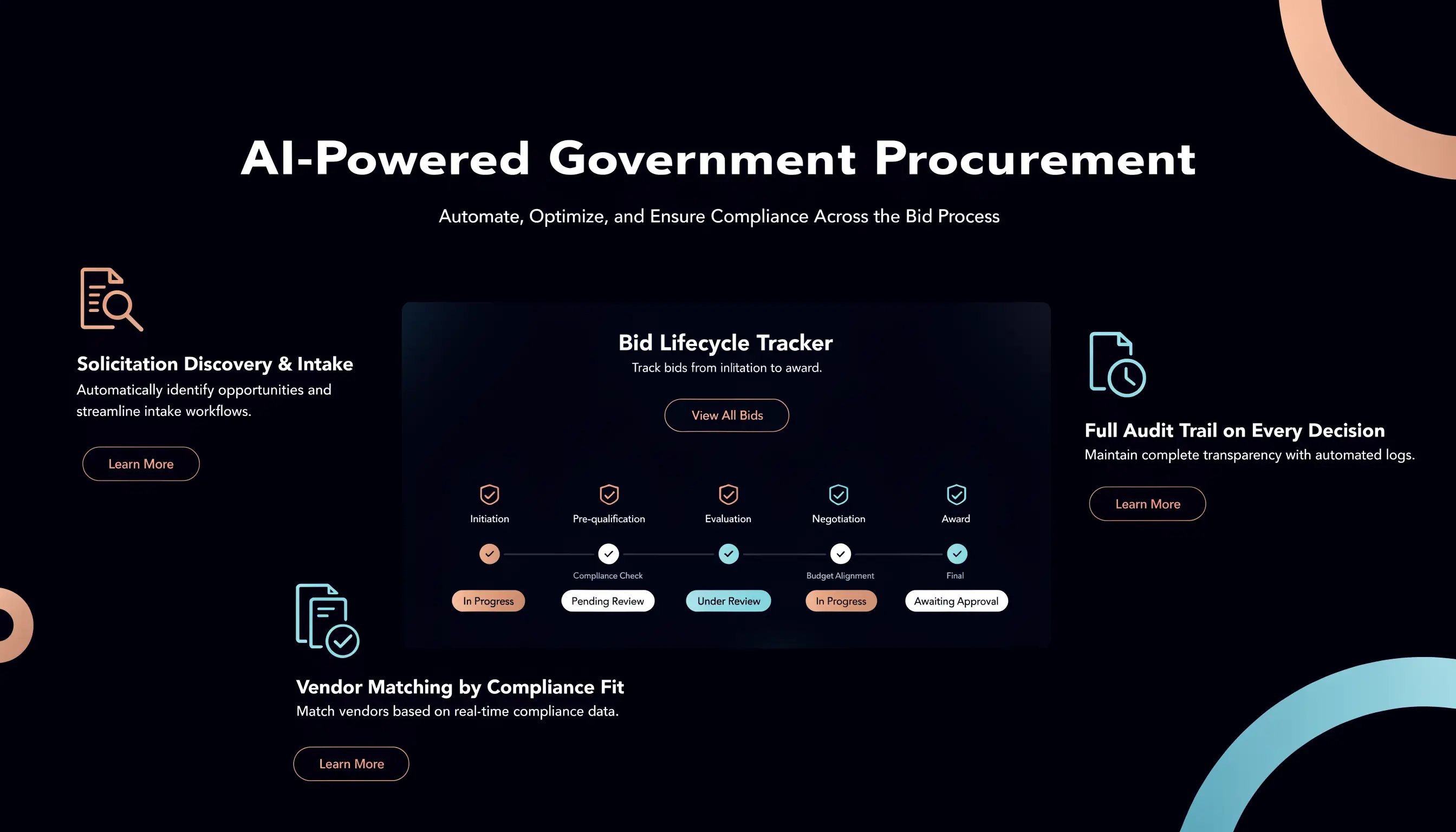
Representative feature highlights. Actual screens vary by deployment and configuration.
Government procurement and acquisition teams and GovCon operators.
What Pulse does.
Solicitation discovery and intake workflows
Vendor matching by category, geography, and compliance fit
Bid lifecycle tracking with approval gates
Line-item pricing and margin support
GovCon, business development, and sales pipeline visibility
Policy checks and full audit trail on every decision
Inside Pulse, capability by capability.
One system, one source of truth
Pulse is one operating system where every department inherits the same tasks, approvals, meetings, files, search, and audit trail.
One shared work graph
Every deal, solicitation, ticket, contract, invoice, and transcript lives in a single indexed graph, so numbers reconcile across departments by construction.
Universal tasks and approvals
A bid authorization, a refund, and a travel request all run through the same audited approvals engine, configured per policy rather than hardcoded.
Permission-aware search
Search spans the whole graph and knowledge base and only ever returns results the user is entitled to see.
Governed handoffs
Departments coordinate through published events and audited handoffs, never by reading each other's tables directly.
AI prepares the work, people commit it
Every AI output is an evidence-backed decision object a person reviews, accepts, edits, or rejects.
Decision objects, not chat
Each recommendation renders inline with its evidence, confidence, and proposed action, and a human approves it before anything happens.
Explainable scoring
Bid win likelihood, lead close, churn, SLA breach, and payment risk are persisted, explainable scores that trace back to source records.
Governed voice capture
Phone calls, dictation, and spoken commands become transcript records in the work graph, with speaker labels, word-level timestamps, and consent handling.
Hard guardrails
The AI never moves money, sends a client message on its own, or submits a federal representation; those actions require an authorized person.
Compliance built into the architecture
Pulse descends from a proven government procurement platform and treats federal compliance as structure, not policy.
SAM.gov to award
Opportunities ingest from SAM.gov and move through bid decisions, vendor matching, line-item pricing, and submission, with approvals at each step.
CUI handling
Data touching federal contracts, including call audio and transcripts, is tagged as CUI, attribute gated, and handled under FAR and DFARS rules.
Human attestation on federal artifacts
Any AI-drafted artifact bound for federal submission requires human attestation before it leaves.
Reviewable activity record
The release is designed to record human and AI actions with actor, timestamp, and source for review; coverage and integrity evidence are release-specific.
What Pulse is for, and what it is not.
Designed for government procurement operations: opportunity intake from SAM.gov, bid decisions, vendor matching, pricing worksheets, and submission packages. Agents draft and score for a human contracting team; award and submission decisions stay with people.
Like every Trunnion product, Pulse is designed to propose, draft, and prepare work for human decision, with consequential actions pausing at a human approval gate. AI outputs may be inaccurate, incomplete, or unsuitable and should not be the sole basis for a consequential decision affecting a person. Expected inputs, model providers, known failure modes, and the exact human review points for a deployment are documented in the release documentation and written agreement. See theAI transparency notice and theAI acceptable use policy.
Pulse: key facts.
| Product | Pulse: Procurement Workflow Platform |
|---|---|
| Category | Government Procurement |
| Status | Live |
| Platform | Trunnion control plane: governed multi-agent orchestration |
| Governance | Designed for policy-based authorization and layered tool controls; verified per release |
| Audit | Reviewable execution records; integrity and replay verified per release |
| Human oversight | Human-in-the-loop approval gates on consequential actions, by design |
| Model posture | LLM-agnostic model routing, hosted or on-premise |
| Deployment | Cloud, on-premise, or fully air-gapped |
| Classification | Designed for classification-aware workflows up to TS/SCI; accreditation determined per environment |
| Security alignment | Engineered to align with NIST SP 800-53 control families; alignment by design, ahead of formal certification. |
| Developer | Trunnion AI, LLC, a Duskbridge company |
Governed by design, like every Trunnion product.
Pulse inherits the platform's governance, audit, and deployment patterns instead of rebuilding them: policy on every action, a human operator in command, and a record you can hand to an auditor.
Policy-aware governance
Attribute-based access control (ABAC) is designed to decide what every agent may see and do, per tenant, role, and classification.
Human-in-the-loop gates
Consequential actions are designed to pause for a named operator to approve, edit, or reject before anything executes.
Reviewable execution records
The architecture is designed to record actions, approvals, and supporting traces for review. Cryptographic implementation is verified per release.
Common questions about Pulse.
Can the AI pay an invoice or submit a bid on its own?
No. The AI drafts and recommends only. Money movement, client messages, and federal submissions always require an authorized person, and every action lands in the audit log.
How does Pulse handle CUI and federal data requirements?
CUI is tagged and attribute gated under FAR and DFARS rules, the architecture is designed with government boundary deployment in mind, and moving to a compliant boundary is a configuration change, not a rewrite.
What systems does Pulse connect to?
SAM.gov for opportunities, Stripe for payments, Plaid for banking, Google, Otter for meetings, and ElevenLabs Scribe for voice, plus payroll, engineering, and monitoring tools.
Next step
See Pulse against your workflow.
Request a demo and see the governed control plane run in your environment, from cloud to air-gap.